 |
| From my room this morning in Colombo |
Thursday, November 03, 2011
A Room With a View


Tuesday, November 01, 2011
Sandstone and gold
 |
| The Mahabodhi Temple this morning |
Dzongsar Khyentse Rinpoche, who was in Bodh Gaya for the INEB conference, commented casually that the first temple was destroyed and this one was built by Muslims. Apparently, they then built a mosque on the site of the original temple, which was not next to the Bodhi tree but on a plot that is outside the current temple complex. (He then wondered if the mosque was for sale.)

This is Wat Pa Buddhagaya, which is one of at least six Thai temples in Bodh Gaya, and the site of the main conference. Its right behind the Mahabodhi Temple grounds, and you can see the spire in the distance. I snuck up on the roof of the monks' quarters with a few Thai artists to take pictures. (Here we are in a rather serious pose.) They told me that this temple is created for the Forest monks tradition and the art is in a style typical of Chiangmai.

While he was here, Aut (center), installed the new lotus throne in the inner courtyard behind the Bodhi tree, which is usually inaccessible. (My pictures are only through the sandstone fence around it). He told me that he was at the temple until 4am doing the gold leaf, and had caught a cold in the process. I'm not sure who commissioned him, but it underscores what an international project the Mahabodhi Temple is. Later that week, Richard Dixie told me that the new gold spire of the temple was created and installed by Nepali master metalsmiths who had to scale the face of the temple to put it on.

Here's the view behind us that isn't usually seen from the town. I wish all of Bodh Gaya were like this! The streets get a bit dusty and its easy to forget we're just a few minutes from verdant fields.

Monday, October 31, 2011
The Tree (and piglets)

The last 2 weeks in Bodh Gaya at the INEB conference have been amazing. This is a descendent of the bodhi tree under which Siddhartha was enlightened, on the same spot with the shrine erected around it. I've visited it just about everyday, what a powerful place. In touching my forehead as the pilgrims do, I could almost hear him breathe, feel his skin. His presence is palpable.
I've a lot to catch up on, since I haven't been on the internet much this whole time. But I find it only fitting to begin here. ...and to add an adorable picture of pigs. This is sort of what Bodh Gaya is like--a mind-blowing juxtaposition of the most sacred spot in all of Buddhism and families of pigs sleeping under a little shack on the way to a little concrete coffeeshop that serves carrot cake and cappuccino.

Monday, October 17, 2011
London: The Tate Modern

(btw, I'm not that keen on Virgin America but love Virgin Atlantic. It was the easiest flight over.)
Saturday, October 08, 2011
Back to the beginning
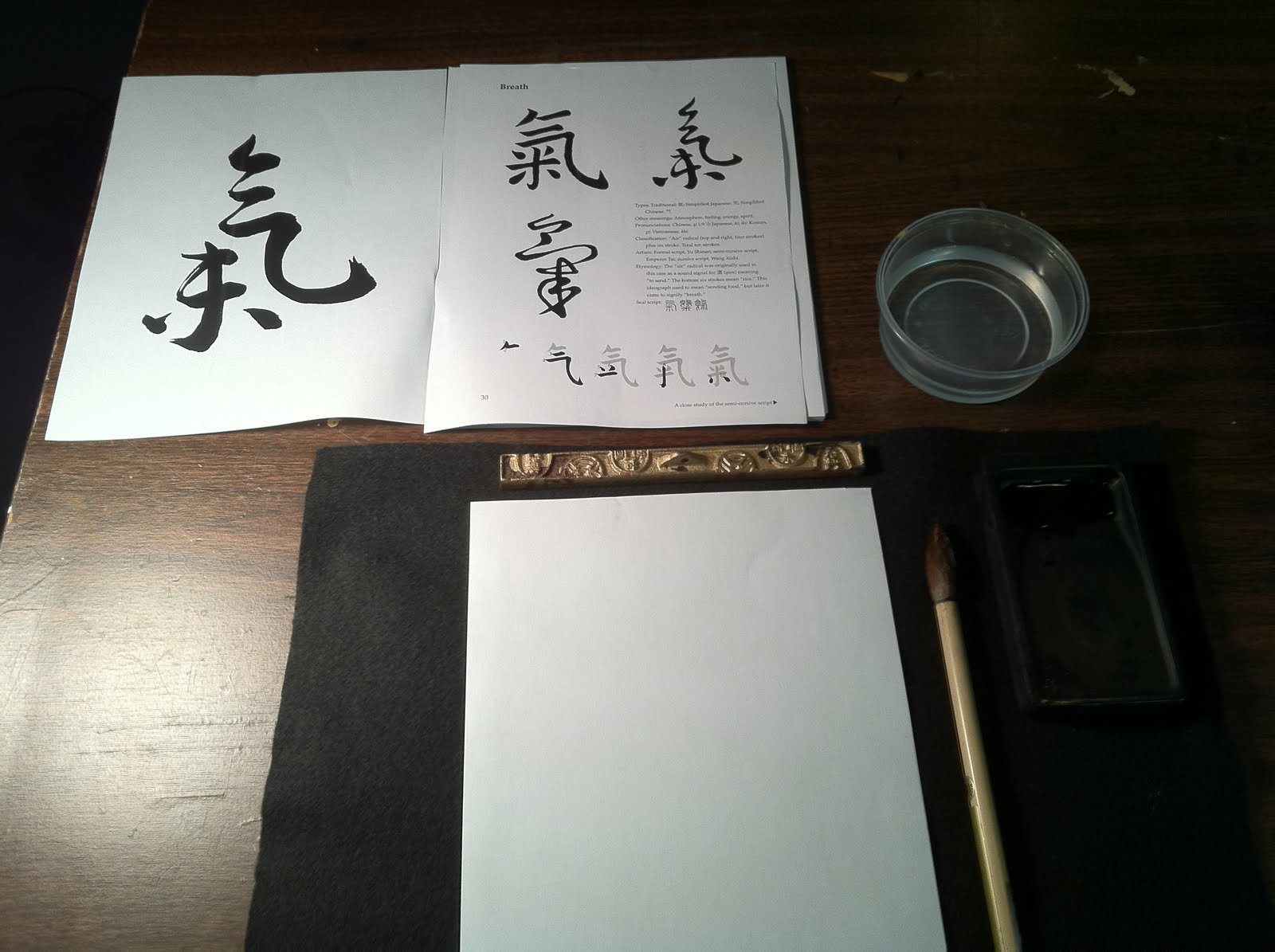
Today I had the opportunity to return to the source of all my work, calligraphy.
I am staying and working in the home of my calligraphy teacher, and I feel so blessed. This week marked a significant end and a remarkable beginning. On the one hand, I packed up and left everyone and everything I called home for the past two years. On the other, I have been given the opportunity to rediscover my roots as I embark on a new journey. For this, I am supremely thankful.
Monday, July 11, 2011
When We Were Kids

I'm delighted to run back to my brushes and pencils after working with technology so much in the last two years.
My good friend James Garcia has put together a wonderful show dubbed "When We Were Kids", featuring Christopher De Leon, James and myself. Its opening at 1AM Gallery in San Francisco this Friday, July 15 and runs 'til August 14.

Hulahoop Girl (2011)
ink and pencil, 9 in x 12 in
ink and pencil, 9 in x 12 in

Sampaguita Kid (2011)
ink and pencil, 9 in x 12 in
ink and pencil, 9 in x 12 in
Sunday, May 22, 2011
Sonic Physiognomy
 |
A nod to the future and the past, this is an instrument that uses the face as a score for music. |
Sonic Physiognomy is my response to the politicization of the human face, drawing a relationship between the historical practices of physiognomy or face reading and the technologies of facial recognition and iris identification used for tracking and surveillance.
The is a form of live sonic portraiture, and comprises an installation wherein participants volunteer to have their face “scanned” and translated into sound. (For a future interation, each song will be recorded and made available for download to be used as unique sonic signatures in other applications, such as ringtones on cell phones.)
 |
| Detail of exterior wall and interior scanning projection |
The Sonic Portrait installation consists of a “scan pod” that is made of over 615 unique pieces of corrugated cardboard that form the shape of two interlocking spirals.


 |
A subject's silhouette is captured and the topography of the face is read into a unique series of chimes and sonic harmonies. |

 |
Adam Brillhart looking at the translucency of the material during construction |
 |
Interior during construction |
Subscribe to:
Posts (Atom)